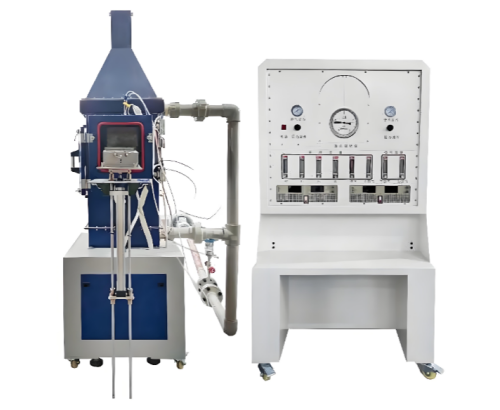
Electro-hydraulic servo dynamic fatigue testing machine
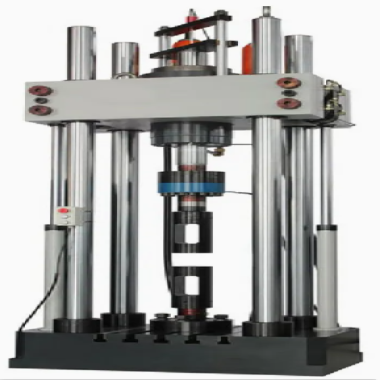


The Electro-Hydraulic Servo Dynamic and Static Fatigue Testing Machine is designed for comprehensive mechanical testing of metals, non-metals, structural components, standard parts, and new high-performance materials, including ultra-strength steel, titanium alloys, and reinforced synthetic fibers. The machine can perform tensile, compression, static, dynamic, low-cycle fatigue, crack growth, and fracture mechanics tests. Fatigue parameters such as fatigue life, cyclic elastic modulus, and fatigue crack growth rate can be measured under symmetric, asymmetric, and alternating load cycles.
Application
(1) Tensile and compression testing of metallic and non-metallic materials.
(2) Fatigue and low-cycle fatigue testing under cyclic or alternating loads.
(3) Measurement of cyclic elastic modulus and fatigue life of components.
(4) Fracture mechanics testing and fatigue crack growth analysis.
(5) Evaluation of structural parts and standard components under dynamic load.
(6) Testing of high-performance materials, including ultra-strength steel, titanium alloy, and reinforced synthetic fibers.
(7) R&D, quality control, and material certification in metallurgy, aerospace, automotive, and engineering laboratories.
Standards
(1) GB/T 2611-2007 — General Technical Requirements for Testing Machines
(2) GB/T 16826-2008 — Hydraulic Servo Universal Testing Machine
(3) GB 3075 — Axial Fatigue Testing of Metals
(4) JB/9379-2002 — Technical Conditions for Tension and Compression Fatigue Test Machines
(5) GB/T 228-2010 — Metallic Materials — Tensile Test at Room Temperature
(6) HB 5287 — Axial Loading Fatigue Test Method for Metal Materials
(7) EN 10002 — Tensile Test of Metallic Materials
(8) JG 556-2011 — Axial Force Fatigue Testing Machine
(9) HG/T 2067-1991 — Technical Specifications for Rubber Fatigue Testing Machines
(10) ASTM E399-09 — Standard Test for K_IC of Metallic Materials (Plane-Strain Fracture Toughness)
(11) ASTM E1820-2001 — JIC Test Standard for Measuring Fracture Toughness
Features
(1) Electro-hydraulic servo actuator for precise static and dynamic loading.
(2) Dual mode testing: static and dynamic fatigue under tensile and compressive loads.
(3) High-stiffness load cell for accurate measurement of static and dynamic forces.
(4) Flexible waveform generation including sine, rectangle, triangle, oblique, and random signals.
(5) Frequency range suitable for low-cycle to high-cycle fatigue testing.
(6) Test force and displacement can be controlled or smoothly converted in real time.
(7) Large test space with adjustable dimensions to accommodate various sample sizes.
(8) Counter for total cycles up to 999,999,999.
(9) Customizable test space and actuator specifications based on user requirements.
Parameters
| Item | Specification |
|---|---|
| Maximum static test force | ±20 kN |
| Static force effective range | 0.4–100% FS |
| Static force accuracy | ±0.5% |
| Maximum dynamic test force | ±20 kN |
| Dynamic force effective range | 4–100% FS |
| Dynamic force accuracy | ±0.5% |
| Force resolution | 1 / 120,000 |
| Load sensing element | High-stiffness fatigue machine load sensor |
| Actuator stroke | 100 mm |
| Maximum working pressure | 21 MPa |
| Maximum displacement | 100 mm |
| Displacement accuracy | ±0.05% |
| Displacement resolution | 1 / 120,000 |
| Displacement sensing element | Differential transformer type |
| Amplitude | ±10 mm (at 16 Hz) |
| Generator frequency | 0.001 – 100 Hz |
| Frequency response range | 0.01 – 60 Hz |
| Maximum continuous working frequency | 6 Hz |
| Test waveform | Sine, rectangle, oblique, triangle, random |
| Counter | 999,999,999 preset |
| Control mode | Force, displacement (smooth conversion) |
| Net test width | 600 mm |
| Net test height | 800 mm |
| Custom test space | According to user requirements |
Accessories
(1) Electro-hydraulic servo actuator and control unit.
(2) High-stiffness load cell.
(3) Test grips and fixtures for tensile, compression, and fatigue testing.
(4) Data acquisition system with real-time waveform display.
(5) Control software with frequency and waveform configuration.
Test Procedures
(1) Select the appropriate test standard and sample geometry.
(2) Install the actuator and appropriate fixture for the sample.
(3) Zero the force and displacement measurement channels.
(4) Configure waveform type, amplitude, frequency, and test duration.
(5) Start the test and monitor real-time force-displacement or stress-strain curves.
(6) Automatic stop upon reaching preset cycles or sample failure.
(7) Save test data for post-processing, analysis, and reporting.
Leave Message Get Price