

UL 94 Horizontal and Vertical Burning (Flammability) Test Guidelines

1. Horizontal Burning Test (HB)
1.1 Overview
HB is the most basic flame-retardant rating in the UL 94 standard. It is used to evaluate the rate of flame spread in plastic materials when placed horizontally, and is primarily applicable to general-purpose plastics and structural components with low flame-retardant requirements. By measuring the burning rate of the specimen under a specified flame, it is determined whether the material meets basic flame-retardant requirements; this is the most fundamental method for screening material flammability.
1.2 Specimen Preparation
The standard specimen dimensions are 125 mm × 13 mm, with a thickness of typically 3 mm or 6 mm; five specimens are prepared per set. The specimen surface must be flat and smooth, free from defects such as bubbles, cracks, burrs or impurities. Mark 25 mm and 100 mm scale lines along the length to measure the burn distance. For materials with a thickness of less than 3 mm, the maximum applicable thickness may be used, provided no significant deformation occurs during the test.
1.3 Sample Pre-treatment
Samples must be conditioned under standard environmental conditions: kept at 23±2°C and 50±5% relative humidity for 48 hours; or kept at 70±1°C for 168 hours. After conditioning, the samples must be sealed and left to stabilise at 23±2°C for 4 hours before testing, to eliminate the influence of moisture and internal stresses on the test results.
1.4 Test Procedure
Clamp the specimen horizontally with the free end inclined downwards at 45°. Use a Bunsen burner to produce a 20 mm high blue flame; apply the flame to the free end of the specimen for 30 seconds, then remove the flame source. Record the burning time taken for the flame to spread from the 25 mm mark to the 100 mm mark; If the flame extinguishes before reaching the 100 mm mark, record the position at which it extinguished. The test shall be conducted in a draught-free environment.
1.5 Classification and HB Assessment Criteria
For specimens with a thickness ≥ 3 mm, the burning rate shall be ≤ 40 mm/min; for specimens with a thickness < 3 mm, the burning rate shall be ≤ 76 mm/min. Alternatively, the specimen shall extinguish spontaneously before reaching the 100 mm mark. A set of five specimens must all meet the requirements to be classified as HB grade. HB-grade materials are classified as slow-burning and possess a certain degree of self-extinguishing properties.
2. 50W Horizontal Burning Test for Foam Materials (HBF, HF-1, HF-2)
2.1 Overview
This method is designed for porous foamed materials such as foam plastics and sponge, using a 50W flame in a horizontal position to test their burning rate, spread characteristics and the risk of ignition by molten droplets. HBF is the basic flame-retardant grade, whilst HF-1 and HF-2 impose stricter requirements, focusing on the restriction of flaming molten droplets; these are commonly used for foam materials in sectors such as household appliances, automotive and building insulation.
2.2 Sample Preparation
Specimen dimensions are 150 mm × 50 mm × 13 mm, with five specimens per set. The specimens must have uniform cell structure and be free from damage or collapse. Marking lines at 25 mm, 60 mm and 125 mm must be applied to the specimens. During testing, a metal wire mesh must be used to support the specimens to prevent sagging or deformation during combustion, which could affect the results.
2.3 Specimen Pre-treatment
Conditions are consistent with those for the HB test: 48 hours at 23 °C/50% RH or 168 hours at 70 °C. As foam materials readily absorb moisture, thorough pre-treatment ensures stable combustion performance; testing must be conducted after the samples have stabilised following pre-treatment.
2.4 Test Procedure
Place the specimen horizontally on the support grid and apply a 20 mm flame to the free end for 60 seconds before removing it. Record the burning time and the position at which the flame extinguishes at each mark, whilst observing whether the drippings from the specimen ignite the dry, degreased cotton located 300 mm below, to assess the risk of molten droplets igniting the cotton.
2.5 Classification Criteria for HBF, HF-1 or HF-2
HBF: Burning rate ≤ 40 mm/min, or self-extinguishes before reaching 125 mm;
HF-1: The flame self-extinguishes before 60 mm, with no flaming molten droplets, and does not ignite the cotton;
HF-2: The flame self-extinguishes before 125 mm, with no flaming molten droplets, and does not ignite the cotton.
3. 50W 20mm Vertical Burning Test (V-0, V-1, V-2)
3.1 Overview
This is the most widely applied flame-retardant test in UL 94, involving two ignitions of a vertical specimen using a 50W/20mm flame to assess the material’s flaming burn time, smouldering time and melt-drip behaviour. The flame-retardant ratings are V-0 > V-1 > V-2, and are commonly used for components with high safety requirements, such as electrical enclosures, structural parts and PCB substrates. 3.2 Specimen Preparation
Specimen dimensions: 125 mm × 13 mm, thickness:
3.1 Overview
This is the most widely used flame-retardancy test in UL 94. It involves igniting a vertical specimen twice using a 50 W/20 mm flame to assess the material’s flaming time, afterglow time and drip behaviour. The flame-retardancy ratings are V-0 > V-1 > V-2, and the test is commonly used for components with high safety requirements, such as electrical enclosures, structural parts and PCB substrates.
3.2 Specimen Preparation
Specimen dimensions: 125 mm × 13 mm, with a thickness corresponding to the material’s actual service thickness (0.8–13 mm); five specimens per group. The surface must be flat and free from defects; no scale markings are required. The test focuses on observing after-flame, after-glow and dripping behaviour.
3.3 Sample Pre-treatment
Same as for HB: conditioning at 23±2°C/50% RH for 48 hours or heat treatment at 70°C for 168 hours. Testing shall be conducted after stabilisation to ensure repeatability of results.
3.4 Test Procedure
The specimen is fixed vertically; a 20 mm flame is applied to the lower end for 10 seconds before being removed, and the time t1 of the first flaming combustion is recorded; after the flame has extinguished, the flame is reapplied for 10 seconds, and the time t2 of the second flaming combustion and the subsequent afterglow time t3 are recorded. At the same time, observe whether the molten droplets ignite the cotton below.
3.5 Evaluation Criteria for V-0, V-1 and V-2 Classifications
V-0: Single-strand afterglow ≤ 10 s, total afterglow ≤ 50 s; no afterglow extending to the fixture; no molten droplets igniting the cotton;
V-1: Single-strand afterglow ≤ 30 s, total afterglow ≤ 250 s; no molten droplets igniting the cotton;
V-2: Afterglow times as for V-1, but molten droplets are permitted to ignite the cotton.
4. 500 W (125 mm) Vertical Burning Test (5VA, 5VB)
4.1 Overview
This test represents the highest flame-retardant rating under UL 94, utilising a 500 W high-intensity flame. It is suitable for structural components and enclosure materials requiring high flame-retardancy. The 5VA rating is higher than 5VB, requiring the material to remain non-combustible under intense flame, without forming holes or exhibiting significant melting drips.
4.2 Specimen Preparation
4.2.1 Strip Specimens
Dimensions: 125 mm × 13 mm × actual thickness; five specimens per set.
4.2.2 Panel Specimens
Square specimens measuring 150 mm × 150 mm, with a thickness corresponding to the product’s actual thickness in use, are used to assess the burn-through resistance of large-area panels.
4.3 Specimen Pre-treatment
Pre-treatment conditions are as described above: 23 °C/50% RH for 48 hours or 70 °C for 168 hours; testing is conducted after stabilisation.
4.4 Test Procedure
4.4.1 Test Procedure for Strip Specimens
Clamp vertically, apply a 125 mm flame for 5 s, pause for 5 s, and repeat five times. Record the after-flame and after-glow times, and observe for burn-through, dripping and ignition of the cotton.
4.4.2 Test Procedure for Square Specimens
Apply the flame at an angle to the square panel to assess whether burn-through, holes, sustained burning or dripping occurs.
4.5 Classification Assessment Criteria for Classes 5VA and 5VB
5VB: Burn-through of the specimen is permitted, provided that after-flame and after-glow extinguish within the specified time and there is no destructive dripping;
5VA: Burn-through is not permitted; there must be no sustained burning or ignitable molten droplets; this represents the most stringent flame-retardant requirement.
5. Vertical Burning Test for Thin Materials (VTM-0, VTM-1, VTM-2)
5.1 Overview
Applicable to flexible materials such as films and sheets, typically with a thickness of ≤0.13 mm, e.g. packaging films, adhesive tapes and insulating films. The test method is similar to the V-class test but is optimised for thin, easily curling materials; the rating scale is VTM-0 > VTM-1 > VTM-2.
5.2 Specimen Preparation
Specimens shall be 200 mm × 50 mm films, clamped along the length to ensure they are flat and free of creases; five specimens shall be provided per test group.
5.3 Sample Pre-treatment
As with other UL 94 tests, the samples are conditioned for temperature and humidity or heat-treated, and tested after stabilisation.
5.4 Test Procedure
The sample is suspended vertically and exposed to a standard flame twice, for 3 seconds each time. The burning time, curling behaviour, molten droplets and ignition of the cotton below are recorded.
5.5 Classification Criteria for VTM-0, VTM-1 or VTM-2
VTM-0: Extremely short after-flame; no molten droplets ignite the cotton;
VTM-1: Slightly longer after-flame; no molten droplets ignite the cotton;
VTM-2: Molten droplets are permitted to ignite the cotton; otherwise, same as VTM-1.
6. What equipment is required for UL 94 horizontal and vertical burning tests?
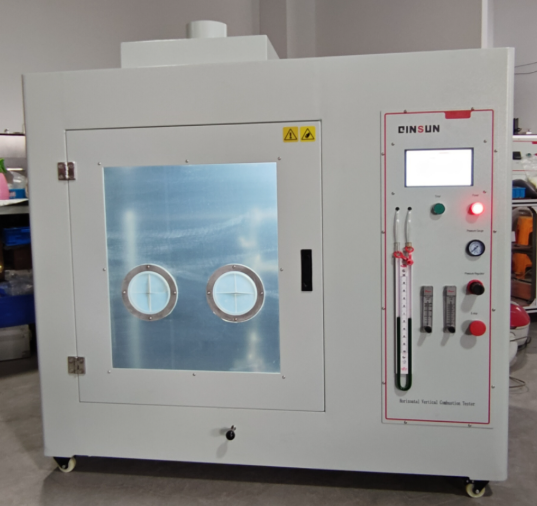
The UL 94 combustion test system primarily comprises: a Bunsen burner (gas control system), specimen clamping fixtures, horizontal/vertical combustion test chambers, a timing device, dried degreased cotton, a metal support grid, a draught-free test chamber with controllable air velocity, a temperature and humidity control chamber, a desiccator, temperature measurement devices, and a gas flow meter. The complete set of equipment must meet requirements for ventilation, explosion protection, adjustable ignition height and flame length calibration to ensure test safety and data accuracy.
2026-04-14 17:03
- Related News
How to Choose a Suitable Drying Rate Tester?
What Is a Fabric ICI Pilling and Snagging Box?
How to Choose an ICI Mace Snag Tester?
What a Fiber Oil Extractor Actually Does?
Snap Button Pull Tester: Garment Accessory Tensile Strength Testing Guide
Guide to Block-on-Ring Friction Wear Equipment
How to Choose Universal Multifunction Tribology Test Machine
How to Choose an Air-Cooled Xenon Lamp Aging Chamber
What Does an Ozone Aging Chamber Test? Standards and Operating Methods
Fabric Cool Feeling Tester: Working Principle, Standards and Selection Guide