SPF Tester | Fabric UV Resistance Tester
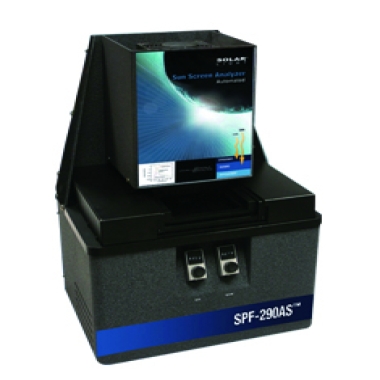


The Fabric UV Resistance Tester is designed to simulate solar UV radiation and evaluate the ultraviolet protection performance of textiles, sun-protection products, and cosmetics. The instrument replaces in-vivo testing, providing accurate SPF measurement, UVA/UVB analysis, and critical wavelength evaluation. It combines a stable UV-visible light source, spectrophotometric detection, and powerful data analysis software, offering fast, economical, and reproducible testing.
Application
Assessing SPF value, UVA/UVB absorption, and UV protection of fabrics, sunscreens, and cosmetics.
Research & development of UV protective clothing and sun-care products.
Quality control in textile manufacturing, cosmetics production, and certification labs.
Replaces human body (In-Vivo) testing for cost-effective and standardized UV evaluation.
Standards
AATCC 183 – Determination of SPF for textiles
AS/NZS 4399 – Sun Protective Clothing Standard
ISO 24443 – In vitro determination of sunscreen UVA protection
Colipa 2011 – European sunscreen testing standard
FDA – Sun protection product guidance
Other international UV protection standards
Features
Covers UVA and UVB spectral region, 290–400 nm, wavelength repeatability: 0.25 nm, monochrome resolution: 1.66 nm, wavelength accuracy: ±0.2%.
Data acquisition and analysis software: automatic calculation of UVA, UVB, UPF, critical wavelength, Boots Star rating, and MPF/absorbance values. Supports up to 36 cumulative tests.
125 W Xenon arc light source with high-performance integrating sphere for stable and uniform UV radiation.
One-year NIST traceability ensures reliable calibration and accuracy.
High linearity: 99.997%.
Software-controlled sampling platform allows automatic scanning, timing measurement, 12 sampling points, and continuous test automation.
NIST verification calibration kit included for user calibration and maintenance.
Technical Parameters
| Parameter | Specification |
|---|---|
| Spectral Range | 290–400 nm (UVA & UVB) |
| Wavelength Repeatability | 0.25 nm |
| Monochrome Resolution | 1.66 nm |
| Wavelength Accuracy | ±0.2% |
| Light Source | 125 W Xenon arc lamp |
| Light Stability | High stability, uniform irradiation |
| Data Storage | Cumulative up to 36 tests |
| Sampling Points | 12 points, automatic scanning |
| Automatic Test | Yes, continuous test with auto-stop |
| Software Functions | UPF, UVA, UVB, MPF, critical wavelength, Boots Star rating, absorbance |
| Calibration | NIST traceable kit |
| External Dimensions | 460 × 320 × 350 mm |
| Power Supply | 220V AC, 50Hz |
| Weight | 80 kg |
Accessories
Xenon arc lamp module
NIST calibration verification kit
Computer interface and software
Sample holders and scanning platform
Test Procedures
Prepare sample: Mount textile or product in sample holder.
Set test parameters: Select test mode, number of sampling points, and UV intensity.
Start test: Automatic scanning and measurement of UVA/UVB transmission.
Data analysis: Software calculates SPF, UPF, critical wavelength, and Boots Star rating.
Save/export results: CSV or graphical format for reporting.
Calibration check: Use NIST kit to ensure accuracy before testing critical samples.
FAQ
1. What is the difference between UPF and SPF in these tests?
UPF (Ultraviolet Protection Factor) is the standard used for fabrics and clothing, measuring both UVA and UVB transmission through the material. SPF (Sun Protection Factor) is primarily used for cosmetics and sunscreens applied directly to the skin. This instrument is capable of calculating both.
2. Why is "Critical Wavelength" important for sun-protection products?
The critical wavelength indicates the breadth of UV protection. If the critical wavelength is over 370 nm, the product is considered "Broad Spectrum," meaning it provides significant protection across both the UVB and UVA ranges.
3. Can this instrument test the UV resistance of wet fabrics?
Yes. Many standards, such as AS/NZS 4399. require testing fabrics in both dry and wet states, as moisture can significantly change the UV transmittance of certain fibers.
4. How does the integrating sphere improve test accuracy?
Textiles are often textured or porous. An integrating sphere collects all transmitted light—including scattered light—and averages it, providing you with a much more accurate "total transmittance" value than a standard directional sensor.
5. How often should the NIST-traceable calibration be performed?
While a monthly check using the internal kit is recommended, a full professional recalibration of the NIST standards is typically suggested every 12 months to maintain official lab certification.
Leave Message Get Price