Pendulum Skid Resistance Tester (Pendulum Friction Tester)


1. Introduction:
With the rapid development of transportation, higher requirements have been placed on the research and testing methods for the skid resistance of highways, urban roads, and airport runways. Our institute, together with relevant research organizations, has developed a new generation of pendulum skid resistance tester. The instrument is stable and reliable, easy to adjust, simple to operate, and provides accurate test data comparable to similar foreign products. It can be used both indoors and outdoors, on-site, and is an ideal instrument for skid resistance testing in construction and maintenance.
2. Principle:
The Pendulum Skid Resistance Tester is a dynamic pendulum impact-type instrument. It is developed based on the principle that “the loss of potential energy of the pendulum is equal to the work done against friction when the rubber slider on the pendulum arm slides over the road surface.”
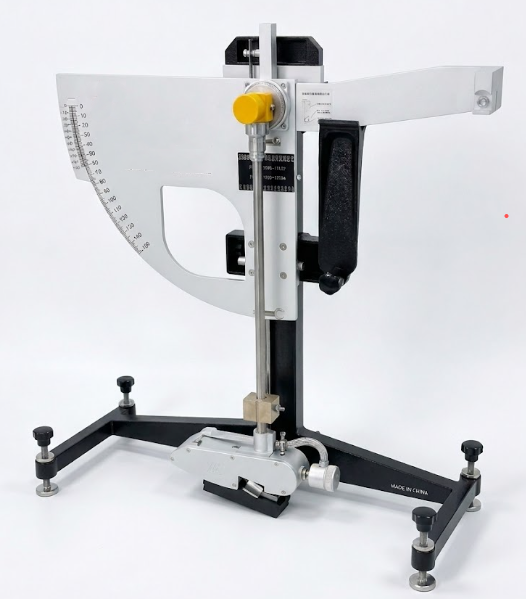
3. Structure (see Figure 1):
(1) Base: Composed of T-shaped legs, leveling screws, and a spirit level, used for leveling and supporting the instrument.
(2) Column: Composed of column, lifting mechanism, guide rod, and handle, used for lifting and fixing the pendulum head position.
(3) Release switch: Installed on the cantilever, used to hold the pendulum in a horizontal position and release it.
(4) Steering system: Includes fastening handle, pivot shaft, universal joint, and bearings, ensuring free swing within the plane.
(5) Indication system: Includes pointer felt ring, pressing cover, pointer adjustment nut, and dial, directly indicating the pendulum value.
(6) Pendulum head: Composed of upper and lower joints, pendulum rod, spring, lever, lifting handle, hammer shell, slider, and rubber pad (76 mm × 25.4 mm × 6.35 mm). It provides a specified torque
at the swing center and a specified pressure on the road surface. The force balance is maintained front/rear and left/right, serving as the measure of surface friction coefficient.
4. Main Technical Parameters:
(1) Pendulum mass: 1500 ± 30 g
(2) Static normal force of rubber pad: 2263 g (22.2 N)
(3) Rubber pad size: 76 mm × 25.4 mm × 6.35 mm
(4) Distance from pivot to center of mass: 410 ± 5 mm
(5) Distance from rubber pad edge to pivot: 508 ± 2 mm
(6) Total weight: approx. 12 kg
5. Operating Method:
(1) Selection of test points:
Select five representative points along the left wheel track in the driving direction, spaced 5–10 m apart.
(2) Leveling:
(1) Place the instrument at the test point with swing direction aligned with traffic direction.
(2) Adjust leveling screws to center the bubble.
(3) Zero adjustment:
(1) Loosen fixing handle, raise pendulum head so it swings freely without contacting the surface, then fix it.
(2) Adjust pointer to zero at vertical free position.
(3) Lift pendulum to horizontal position and lock into release slot.
(4) Release pendulum; ensure pointer returns to zero. Adjust if necessary.
(4) Calibration of sliding length:
(1) Clean surface within swing area.
(2) Align scale with pendulum rod and rubber pad.
(3) Adjust position to ensure correct contact and calibrate sliding length to 126 ± 1 mm while maintaining level.
(5) Testing:
Wet the surface and clean with brush. Release pendulum to slide over the surface. Record readings (first reading may be ignored). Repeat five times (wetting each time). Difference between readings shall not exceed 3 units.
(6) Test results:
(1) Average of five readings at each point is the pendulum value of that point; average of five points represents the test section.
(2) Pendulum value divided by 100 equals friction coefficient (e.g., 33 → 0.33).
(7) Precautions:
(1) Record test date and surface temperature.
(2) Describe pavement type, condition, and service life.
(3) Always catch pendulum during return swing.
(4) Ensure no unevenness within sliding area.
(5) Do not force sliding during calibration.
(6) Select lowest friction areas (left wheel track).
(7) New rubber pad must be conditioned before use; replace if wear exceeds limits. Valid period is one year.
(8) Do not adjust positioning screws after calibration.
6. Maintenance, Storage, and Transportation:
(1) This is a precision instrument; protect all components. Do not disassemble except permitted parts.
(2) Clean after use and store in a dry, ventilated environment free of corrosive vapors.
(3) Store and transport in the case except during operation.
(4) Use transport box for long-distance transport; avoid shock and vibration.
Packing List:
(1) Main unit (1 set)
(2) User manual and certificate (1 set)
(3) Slider (1 piece)
(4) 126 mm scale (1 piece)
(5) Plastic scraper (1 piece)
(6) Wrench (14 × 17 mm) (1 piece)
(7) Water container (1 piece)
7.Figures:
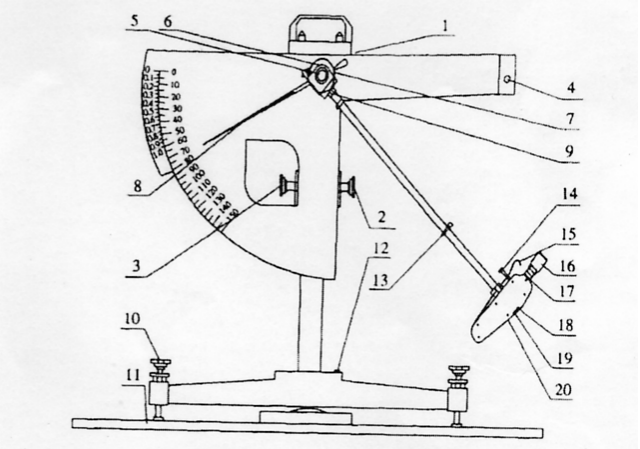
Schematic Diagram:
1- Fastening handle; 2、3- Lifting handles; 4- Release switch; 5- Steering joint screw cap; 6- Adjustment nut; 7- Needle spring or felt pad; 8- Pointer; 9- Connecting nut; 10- Leveling bolt; 11- Base; 12- Spirit level; 13- Snap ring; 14- Positioning screw; 15- Lifting handle; 16- Counterweight; 17- Lock nut; 18- Slider; 19- Rubber pad; 20- Anti-slip screw
FAQ
1.What is a Pendulum Skid Resistance Tester?
A Pendulum Skid Resistance Tester is a device used to measure the skid resistance of various surfaces, such as pavements, tiles, or roads. It simulates the action of a foot or vehicle tire slipping on a surface, providing quantitative data to assess safety levels under wet or dry conditions.
2.How does a Pendulum Skid Resistance Tester work?
The tester operates by swinging a pendulum arm with a rubber slider attached to its end across the surface being tested. The angle of the pendulum's swing is measured, and the resulting values indicate the slip resistance. Higher values indicate better skid resistance, essential for ensuring safety in various environments.
3.Why is skid resistance important?
Skid resistance is vital for preventing accidents on roads and walkways. Insufficient skid resistance can lead to slips and falls, especially in wet conditions. By measuring skid resistance with a Pendulum Skid Resistance Tester, property owners and agencies can ensure that surfaces are safe for public use.
4.Who uses Pendulum Skid Resistance Testers?
Pendulum Skid Resistance Testers are commonly used by civil engineers, safety inspectors, and researchers in the fields of transportation and construction. They are also employed by manufacturers of construction materials to ensure their products meet safety standards.
5.What surfaces can be tested with a Pendulum Skid Resistance Tester?
This device can be used on a variety of surfaces, including asphalt, concrete, tiles, and even artificial turf. It is particularly valuable for evaluating surfaces in environments prone to moisture, as it helps determine how different materials perform under slippery conditions.
6.Are there standards for using a Pendulum Skid Resistance Tester?
Yes, there are established standards for conducting skid resistance tests using Pendulum Skid Resistance Testers, such as those set by ASTM (American Society for Testing and Materials) and BS (British Standards). These standards ensure consistent testing methods and accurate results across different applications.
Leave Message Get Price