Impact Specimen Notch Projector GXT-50
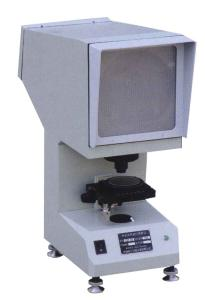


With the development of domestic industrial technology, an increasing number of industries have begun implementing the “Metal Charpy Impact Test Method” standard. This standard imposes strict requirements on the test specimens, meaning that the quality of specimen preparation directly affects the final test results. If the specimen is improperly prepared, the test results cannot be considered reliable. Even minor variations in the specimen notch can cause significant jumps in test outcomes, particularly near critical values, potentially leading to completely opposite results—either the product passes or is rejected. To ensure the notch quality of specimens, quality inspection is a crucial control measure. At present, optical projection magnification is the only practical and effective method for this purpose.
Application
The GXT-50 is mainly used to inspect Charpy impact specimens in materials testing labs, manufacturing plants, and quality control departments. It is suitable for various industries, including steel manufacturing, materials science, and mechanical testing. This instrument is used for testing the notch quality of Charpy V-notches and U-notches in materials such as metals, alloys, and plastics, ensuring the accuracy and reliability of subsequent impact testing.
Standards
GB/T 299-2020: Metal Charpy Impact Test Method (China)
ISO 148-2: Metallic Materials – Pendulum Charpy Impact Test (International)
ASTM E23: Standard Guide for Charpy V-Notch Impact Testing of Metals (USA)
The Impact Specimen Notch Projector was developed to meet the practical needs of users and the requirements for Charpy specimen notches outlined in GB/T 299-2020 “Metal Charpy Impact Test Method.” This optical instrument is specifically designed to inspect the machining quality of Charpy V-notches and U-notches. The device uses optical projection to enlarge the contours of the V- or U-shaped notches of the specimen by 50 times and projects them onto the screen. These projections are then compared with the standard V- and U-notch templates on the screen to determine whether the specimen notch meets the required quality. The instrument offers the advantages of simple operation and intuitive comparison.
Working principle
The light emitted by the projector’s light source is first focused onto the specimen through a condenser lens, and then the objective lens projects the enlarged contour of the illuminated specimen onto the projection screen.
As required, this instrument uses single-projection illumination. The light source is projected onto the worktable through a series of optical elements, and then, through another set of optical components, the contour of the specimen’s notch is clearly projected onto the screen. The specimen undergoes secondary magnification and secondary reflection to form an upright image, so that the image seen on the projection screen corresponds exactly to the actual orientation of the specimen.
Parameters
Parameter | Specification |
Projection screen diameter | 180 mm |
Worktable dimensions (square) | 110 × 125 mm |
Worktable diameter (round) | 90 mm |
Worktable glass diameter | 70 mm |
Worktable travel (longitudinal) | ±10 mm |
Worktable travel (lateral) | ±10 mm |
Worktable vertical travel | ±12 mm (no scale) |
Worktable rotation range | 0–360° (no scale) |
Instrument magnification | 50× |
Objective lens magnification | 2.5× |
Projection objective lens magnification | 20× |
Light source (halogen lamp) | 12 V, 100 W |
Power supply | 220 V, 50 Hz |
Overall dimensions (L × W × H) | 515 × 224 × 603 mm |
Weight | Approx. 18 kg |
Structure
(The structure of the Impact Specimen Notch Projector is shown in the diagram.)
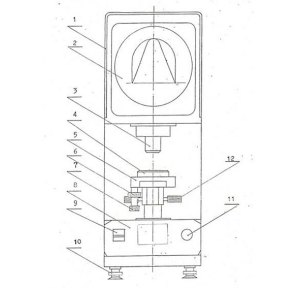
1.Housing
2.Projection screen
3.Objective lens
4.Round worktable
5.Square worktable
6.Longitudinal adjustment handwheel
7.Lateral adjustment handwheel
8.Base
9.Power switch
10.Base screws
11.Power indicator light
12.Vertical adjustment handwheel
Accessories
Component | Quantity/Specification |
Main projector unit | 1 |
Base adjustment knobs | 4 |
Power cord | 1 |
Halogen lamps | 2 |
Flat glass plate | 1 |
Quality Assurance
The equipment is covered by a one-year warranty period starting from the official delivery date. During the warranty period, the supplier will provide prompt and free repair services for any equipment malfunctions. For damage to parts not caused by human factors, the supplier will provide free replacement in a timely manner. After the warranty period, if the equipment experiences any malfunctions during use, the supplier will promptly provide on-site service and actively assist the purchaser in completing the repair tasks.
FAQ
What is this product?
The XT-50 Impact Specimen Notch Projector is an optical instrument designed to inspect the quality of Charpy impact test specimen notches.
What is this product used for?
It is used to verify the notch quality of Charpy V-notches and U-notches in materials, ensuring compliance with relevant standards.
What is the working principle of this product?
The projector uses optical projection to magnify the specimen’s notch and compare it with standard templates to check for accuracy.
Why is this product important?
Proper specimen notch quality is crucial for obtaining reliable Charpy impact test results. This projector ensures that notch dimensions meet required standards, preventing inaccurate test outcomes.
What industries is this product suitable for?
It is suitable for use in materials testing laboratories, steel manufacturing, mechanical testing, and industries where Charpy impact testing is required.
Leave Message Get Price