Chrysler Flex Fold Tester
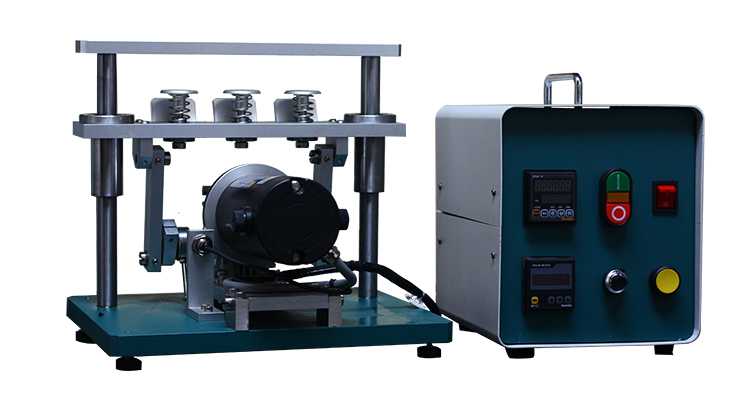


Flex and Fold Tester determines the breakdown resistance of leather, vinyl coated fabric, synthetics, rubberoids, paper, and the like. Product applications which call for flexing and folding may cause your material to split, crack, craze, or separate at the seam. To predict these types of degradation, it is important to simulate the mechanical action taking place in your product's service life environment. The flexing action replicates the physical stresses normally exerted on fabrics and other materials in various automotive, commercial and industrial environments, allowing you to predict the durability of the materials when assembled in their final form.
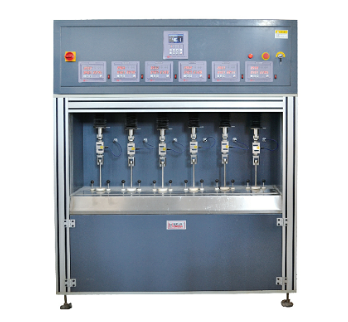
Test specimens are easily clamped into one of four sample positions. Three of these positions perform flex testing. The sample is held under a uniform tension of the while moving one end of while moving one end of the sample through a given distance each side of the perpendicular. This action creates flexural stresses and strain on the sample, which simulates normal wear and causes the material to break down. A change in length of the sample gives a further indication of the material's breakdown.
Once elongated to the point of failure, the bottom of the sample holder triggers a shut-off switch to automatically conclude the test. Upon conclusion of the test, the operator may record the number of cycles indicated on the cycle counter, remove the failed specimen and restart the test for the remaining samples.
The fold test is conducted on the fourth sample, which is clipped into place between two plates at the far end of the instrument. The sample is folded against itself with the finish side out when the two plates are pressed together under a specified tension.
Applications
The Chrysler Flex Fold Tester was designed for the determination of the mechanical stability of anchorage of the coating materials to the backing fabric, due to flexing and folding.
Standards
Chrysler LP-463LB-9-01, Chrysler LP-463KB-13-01, Chrysler LP-463KB-10-01, IFAI J1531, Commercial Standard CS-273-65
Parameters
| Item | Specification |
|---|---|
| Test Type | Flexing and folding durability test |
| Test Capacity | 3 flex specimens + 1 fold specimen |
| Design Type | Tabletop structure |
| Stroke Length | 2.75 inch |
| Clamp Separation | 152 mm (6 inch) |
| Stroke Rate | 35 CPM |
| Tension Load | 8 lbs adjustable |
| Pressure Plate Load | 641 N (12 lbf) when closed |
| Flex Specimen Size | 76 × 203 mm (3 × 8 inch) |
| Fold Specimen Size | 129 × 129 mm (5 × 5 inch) |
| Cycle Counter | Electronic counter with reset function |
| Counter Display | 6-digit |
| External Dimensions | 36 × 12 × 22 inch (L × D × H) |
Features
(1) Simulates repeated flexing and folding stress to evaluate long-term material durability
(2) Supports simultaneous testing of three flex specimens, improving testing efficiency
(3) Independent specimen tension adjustment ensures stable test conditions
(4) Automatic shut-off function stops the test when specimen failure occurs
(5) Electronic cycle counter records the number of flexing cycles accurately
(6) Suitable for testing coated materials where cracking, peeling, or separation may occur during use
(7) Compact tabletop design saves laboratory space and simplifies operation
(8) Applicable to automotive, leather, textile, and industrial material evaluation
FAQ
(1)What materials can be tested with this equipment?
The tester is mainly used for flexible materials such as leather, vinyl-coated fabrics, synthetic leather, rubber sheets, and coated textiles. It evaluates whether materials develop cracks, coating separation, or structural damage after repeated flexing and folding.
(2)What is the purpose of flex and fold testing?
Flex and fold testing simulates repeated mechanical stress during real product use. It helps manufacturers predict durability issues that may appear in automotive seats, interior trims, footwear materials, and other flexible applications.
(3)How are test results evaluated?
Results are usually evaluated by observing the number of cycles completed before failure, along with visible damage such as cracking, peeling, splitting, or changes in material structure according to the applicable test method.
(4)Can this tester evaluate automotive interior materials?
Yes. It is commonly used for automotive leather, coated fabrics, and synthetic materials to verify resistance against repeated bending and folding conditions required by automotive material specifications.
(5)How should a suitable flex testing machine be selected?
Selection should consider the tested material type, required standard, specimen size, loading requirements, and whether flex or fold evaluation is needed. QINSUN engineers can provide suitable testing solutions according to your application requirements.
Leave Message Get Price