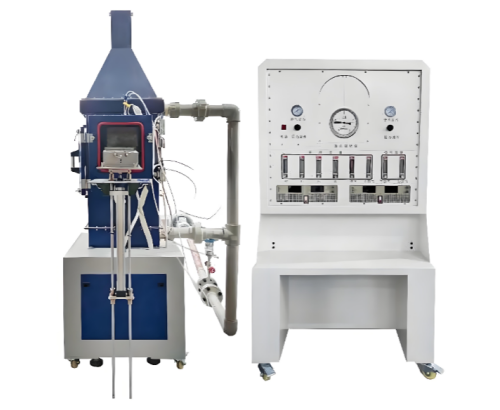
Transient Hot-Wire Liquid Thermal Conductivity Analyzer
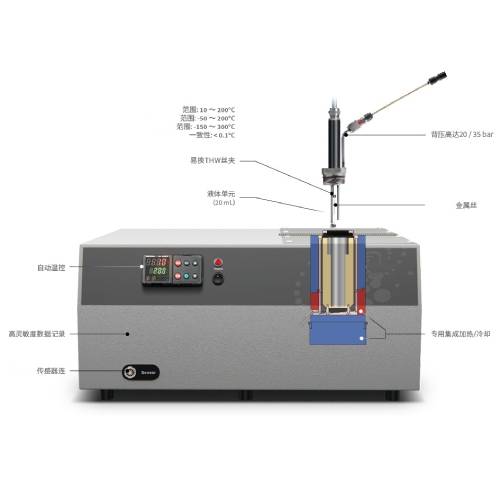


Transient Hot-Wire Liquid Thermal Conductivity Analyzer is a precision instrument designed for accurate measurement of thermal conductivity, thermal diffusivity, and specific heat of liquids, pastes, and powders. Based on the transient hot-wire (THW) method and compliant with ASTM D7896-19. the system enables fast, reliable, and repeatable thermal property characterization using a small sample volume and ultra-short measurement time. It is especially suitable for liquid and phase change material analysis under a wide temperature and pressure range.
Application
The Transient Hot-Wire Liquid Thermal Conductivity Analyzer is widely used in research, development, and quality control environments where accurate thermal property data of fluids and semi-fluids is required. Typical application scenarios include:
Engine coolants, lubricants, and heat transfer fluids
Phase change materials (PCM) for thermal energy storage
Chemical liquids and pastes used in process engineering
High-viscosity fluids and suspensions
Research on thermal transport mechanisms
Typical tested products include engine coolants, PCM slurries, silicone oils, polymer solutions, and specialty chemical fluids.
Standards
The analyzer is designed and tested in accordance with internationally recognized standards:
(1) ASTM D7896-19 — Standard Test Method for Thermal Conductivity, Thermal Diffusivity, and Volumetric Heat Capacity of Liquids Using the Transient Hot-Wire Method
Parameters
| Parameter | Configuration 1 | Configuration 2 | Configuration 3 |
|---|---|---|---|
| Material | Liquids & phase change materials | Liquids & phase change materials | Liquids & phase change materials |
| Thermal Conductivity (W/m·K) | 0.01 – 2 | 0.01 – 2 | 0.01 – 2 |
| Additional Properties | Thermal diffusivity, specific heat | Thermal diffusivity, specific heat | Thermal diffusivity, specific heat |
| Viscosity Range (cP) | 0.001 – 10.000.000 | 0.001 – 10.000.000 | 0.001 – 10.000.000 |
| Sample Volume (mL) | 20 | 20 | 20 |
| Test Time (s) | 1 | 1 | 1 |
| Accuracy (Thermal Conductivity)* | ±2% | ±2% | ±2% |
| Repeatability (Thermal Conductivity)* | ±1% | ±1% | ±1% |
| Temperature Range (°C) | 10 to 200 | -40 to 200 | -160 / -40 / 0 to 300 |
| Pressure (bar) | Up to 20 | Up to 20 | Up to 35 |
| External Cooling Required | No | Yes | Yes |
| Standard | ASTM D7896-19 | ASTM D7896-19 | ASTM D7896-19 |
Features
Transient hot-wire method with ultra-fast 1-second measurement
High accuracy and excellent repeatability for liquid thermal properties
Non-steady-state measurement minimizes convection effects, even for high-viscosity samples
Small sample volume requirement (20 mL)
Wide viscosity, temperature, and pressure measurement capability
Fully compliant with ASTM D7896-19
Accessories
(1) Paste and PCM element — Designed for easy loading of phase change materials; spring-loaded structure accommodates thermal expansion and contraction while maintaining contact with the THW wire
(2) Observation element — Glass viewing port for monitoring sample conditions such as phase separation, boiling, or particle sedimentation
(3) Ambient density powder element — Suitable for basic powder testing at ambient pressure
(4) Variable density powder element — Spiral compression system allows density adjustment and stable wire contact
(5) Vertical element holder — Enables vertical loading for paste, PCM, and powder elements
(6) Cooling system options —
Economic circulator: down to 0 °C
Circulator: down to -15 / -35 / -50 °C
Advanced options: down to -100 / -150 °C
Test Procedures
Sample Preparation
Pour approximately 20 mL of liquid into the selected sample element. The short test duration effectively suppresses convection, allowing accurate measurement across a wide viscosity range. Back pressure up to 35 bar can be applied for measurements above the boiling point.
Approximate time: 1 minute
Sensor Insertion
Insert the THW sensor into the sample element and place it into the integrated temperature platform for controlled testing.
Approximate time: 1 minute
Measurement Execution
The software automatically controls isothermal steps from -150 °C to 300 °C, depending on configuration.
Approximate time: < 1 minute
Result Output
The Windows-based software verifies measurement validity, suggests adjustments if required, and generates reports. Results can be saved, exported to Excel, or sent via email.
Approximate time: 1 minute
Maintenance Information
Keep the THW sensor clean and free of residue after each test
Inspect sensor integrity regularly to ensure stable resistance behavior
Verify temperature control performance periodically
Store sample elements in a clean, dry environment
Follow standard laboratory practices for handling liquids and phase change materials
FAQ
1.What materials can be measured with the Transient Hot-Wire Liquid Thermal Conductivity Analyzer?
The instrument is designed primarily for liquids and phase change materials, but it is also suitable for pastes and powders when used with the appropriate sample elements. Its extremely wide viscosity range, from very low-viscosity liquids to highly viscous materials, allows reliable measurement of thermal conductivity, thermal diffusivity, and specific heat across diverse sample types. The short measurement time further minimizes convection effects, which is especially important when testing low-viscosity or temperature-sensitive liquids.
2.How does the transient hot-wire method determine thermal conductivity?
The THW sensor consists of a 40 mm metal wire that is fully immersed in the sample. A constant current heats the wire, and the resulting temperature rise is recorded through changes in electrical resistance. Thermal conductivity is calculated from the slope of the temperature rise versus logarithmic time curve. A lower slope indicates higher thermal conductivity, while a higher slope corresponds to lower thermal conductivity. This absolute method does not require calibration materials.
3.Why use the transient hot-wire method?
The method provides fast and accurate thermal measurements with minimal sample volume, making it ideal for laboratory and research applications.
4.Why is the measurement time only one second?
The non-steady-state nature of the transient hot-wire method enables extremely fast data acquisition. By limiting the test duration to one second, the influence of natural convection is significantly reduced. This is particularly beneficial when measuring liquids with low viscosity or large temperature gradients, ensuring accurate and repeatable results.
5.Can measurements be performed above the boiling point of a liquid?
Yes. By applying back pressure of up to 35 bar to the sample unit, measurements can be conducted at temperatures exceeding the normal boiling point of the liquid. This capability is especially useful for high-temperature heat transfer fluids and phase change materials.
6.How to choose the right configuration?
Selection depends on temperature range, pressure requirements, and whether low-temperature or high-pressure testing is needed. QINSUN engineers can recommend a suitable configuration based on your application. Contact us for support.
Leave Message Get Price