Automated Scratch Tester
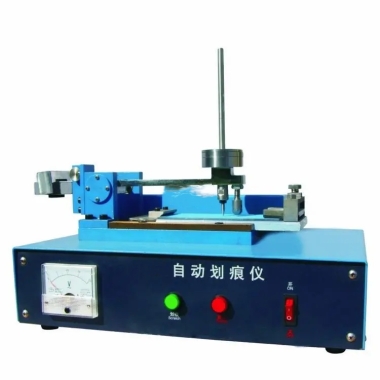


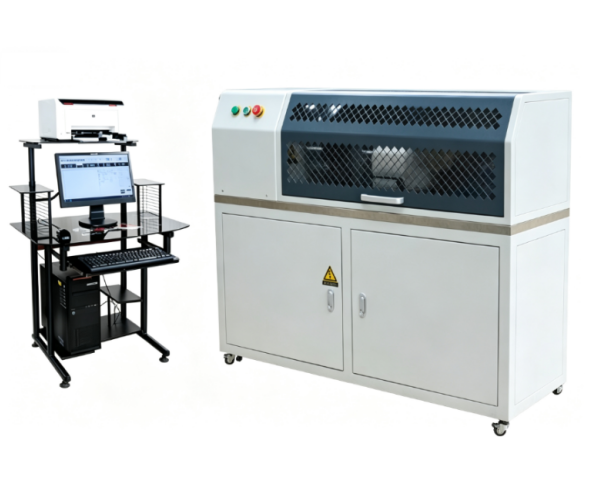
The Automated Scratch Tester is a motor-driven instrument designed for quantitative evaluation of coating scratch resistance. By applying controlled loads to a spherical steel stylus and moving the specimen at a constant speed, the instrument generates repeatable and comparable scratch tracks on coated surfaces. It enables determination of the maximum load at which a coating can resist penetration or failure, making it suitable for both single-layer and multi-layer coating systems used on metal substrates. The system integrates adjustable pressure, defined travel distance, and optional electrical detection to identify coating breakthrough, supporting reliable laboratory testing and routine quality control.
Application
Primary test objects
Coated metal substrates
Coil coatings
Tinplate inks and metal printing coatings
Automotive surface coatings
Pre-painted metal sheets with single or composite coatings
Typical application scenarios
Evaluation of scratch resistance by determining the maximum non-failure load
Simulation of surface damage during handling, transportation, and assembly
Coating formulation development and comparative testing
Incoming material inspection and finished product quality control
Laboratory performance assessment and reliability validation
Standards
(1) GB 9279 Paints and varnishes – Scratch test
(2) ISO 12137-1:1997 Paints and varnishes – Determination of mar and scratch resistance
Parameters
| Item | Specification |
|---|---|
| Input voltage | 220 V AC, 50 Hz |
| Stylus diameter | 1 mm (spherical steel tip) |
| Load range | 50 – 2000 g |
| Standard stroke | 100 mm |
| Specimen size | 150 × 70 mm |
| Test speed | 30 mm/s |
| Adjustable pressure | 0.5 – 20 N (1 – 40 N optional) |
| Overall dimensions | 380 × 300 × 180 mm |
| Shipping weight | 30 kg |
Features
Consistent repeatability through motorized sliding carriage and controlled motion.
Visible load setting using a calibrated movable beam.
Multi-function capability for scratch, abrasion, solvent resistance (MEK), and scrubbing tests.
Multiple speed modes including three fixed speeds and one user-defined speed.
Electrical breakthrough detection for insulating coatings on conductive substrates.
Flexible tooling via a universal adapter compatible with standard or custom test tools.
Accessories
(1) Spare stylus × 2
(2) Load weights:
1000 g × 1
500 g × 1
200 g × 1
100 g × 2
50 g × 2
(3) User manual × 1
Test Procedures
A. Scratch Test (single pass)
Fix the specimen on the sliding carriage using the clamping rail.
Set the desired load on the movable beam according to the scale.
Place the stylus onto the specimen surface.
Start the forward motion to create a scratch.
During the return movement, the guide plate lifts the stylus automatically, allowing lateral repositioning of the specimen.
Use the ruler on the carriage to maintain uniform spacing between scratches.
B. Abrasion Test (reciprocating motion)
Pre-set the number of cycles, pressure, and speed.
Select either circular or square abrasion adapter.
Remove the guide plate and start the test.
Inspect the surface for wear, substrate exposure, or gloss change.
C. Cross-cut (grid) test
Set pressure and speed.
Adjust stroke length using the crank handle.
Move the specimen laterally using the carriage ruler to achieve uniform grid spacing.
D. Solvent and scrubbing resistance test (MEK test)
Install the special felt pad and impregnate it with the test liquid (e.g., MEK, oil, brake fluid, synthetic sweat, or cleaning agent).
Set cycle number, pressure, and speed.
Run the test and observe coating degradation or breakthrough.
Maintenance Information
Clean the stylus and sliding surface after each test to prevent residue buildup.
Regularly check and lubricate the guide rails with light oil.
Do not exceed the specified load range.
Store the equipment in a dry environment to avoid corrosion.
Replace the stylus when noticeable wear occurs.
FAQ
1. What is the core advantage of this product?
Its main advantage lies in stable automated loading and motion control, enabling highly repeatable results across scratch, abrasion, and solvent resistance tests.
2. Are the test results reliable?
Yes. The instrument uses constant-speed motorized movement, quantifiable loading, fixed stroke length, and optional electrical detection to minimize operator variability and improve accuracy.
3. Which standards does it comply with?
It meets the requirements of GB 9279 and ISO 12137-1 for scratch resistance testing of coatings.
4. Why is this product important?
Scratch resistance directly affects coating appearance, durability, and service life. This tester provides measurable, comparable, and traceable data essential for coating development and quality assurance.
5. Which industries is this product suitable for?
Paints and coatings industry
Automotive and components
Metal packaging and coil coating
Appliances and pre-painted building materials
Research laboratories and third-party testing institutions
Leave Message Get Price