Bicycle Dynamic Durability Tester
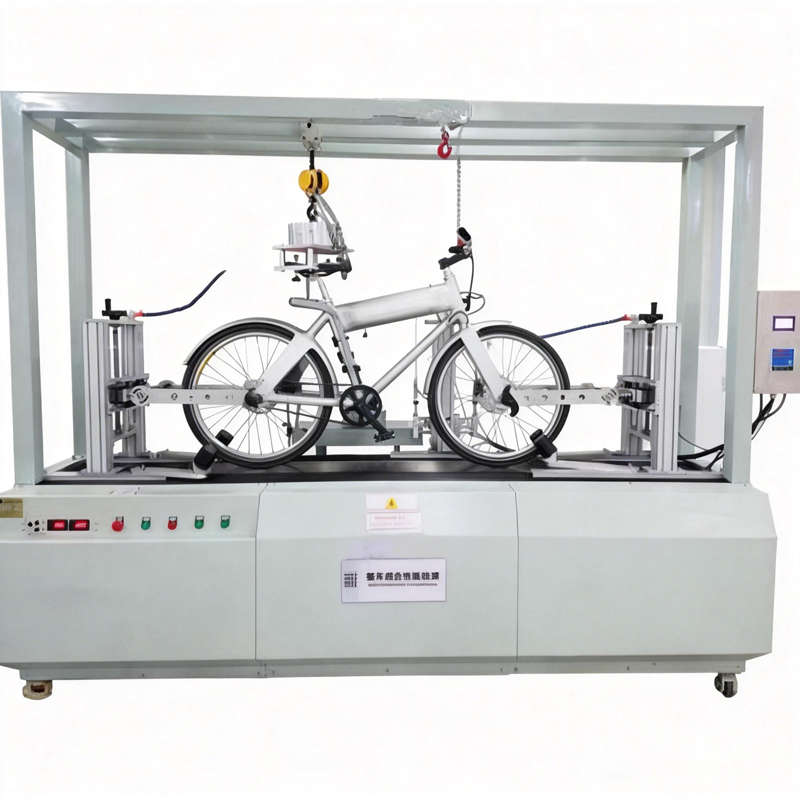


The Bicycle Dynamic Durability Tester is designed to simulate the periodic loads and road impacts encountered during real-world cycling. Combining drum-driven rolling with bump impact, the machine conducts long-term dynamic fatigue testing on complete bicycles under specified load and speed conditions. It evaluates frame strength, assembly reliability, and the durability of key components, making it ideal for type testing, quality control, and R&D validation of bicycles.
Application
This tester is widely used for dynamic durability and fatigue performance testing of bicycles and related products. Its applications include but are not limited to:
(1) Dynamic durability testing of city and commuter bicycles
(2) Fatigue and impact durability testing of mountain bikes (MTB)
(3) Road bike dynamic rolling and structural stability testing
(4) Foldable bicycle durability and assembly reliability assessment
(5) E-bike dynamic durability and suspension system testing
(6) Dynamic fatigue and response testing of front forks and rear suspension
(7) Durability verification of tires, hubs, spokes, and wheel assemblies
(8) Dynamic load performance evaluation for bicycles with varying wheelbases
Compliance Standards
(1) GB 3565—2005 — Bicycle Safety Requirements
(2) GB/T 35563—2017 — Electric Bicycle General Technical Conditions
(3) GB/T 38146—2019 — E-Bike Technical Specifications
(4) ISO 4210 Series — Bicycle Safety Requirements and Test Methods
(5) EN 14764 — City and Touring Bicycle Safety Requirements
(6) EN 14766 — Mountain Bicycle Safety Requirements
(7) EN 14781 — Road Bicycle Safety Requirements
(8) JIS D 9401 — Bicycle Safety and Durability Test Methods
Technical Parameters
| Item | Technical Specification |
|---|---|
| Maximum Load Mass | 110 kg |
| Hub Width | 200 mm |
| Drive Drum Diameter | 400 mm |
| Maximum Test Speed | 20 km/h |
| Wheelbase Range | 1100–1400 mm (customizable) |
| Bump Height | 15 mm (2 per front/rear wheel, replaceable) |
| Maximum Test Cycles | 1,000,000 cycles |
| Bump Pass Count | Digital input, frequency-controlled |
| Display Parameters | Time, speed, bump pass count |
| Control Method | PLC + touchscreen |
| Stop Modes | Manual / preset value / safety switch |
| Cooling | External fan (user-supplied) |
| Weight Configuration | 20 kg × 5, 10 kg × 1 |
| Frame Structure | Aluminum profile frame with electric hoist |
| Overall Dimensions | 2500 × 1000 × 2500 mm (excluding control box) |
Features
(1) Drum drive with bump impact simulates real riding road conditions
(2) Front and rear wheels can be tested simultaneously for higher efficiency
(3) Adjustable wheelbase accommodates multiple bicycle models
(4) PLC touchscreen allows intuitive parameter setting and real-time monitoring
(5) Variable-frequency speed control ensures stable, repeatable operation
(6) Modular aluminum frame simplifies installation, maintenance, and future upgrades
(7) Multiple safety stop mechanisms enable unattended long-term testing
(8) Optional temperature alarm for automatic stop enhances operational safety
Accessories
| Category | Name | Description |
|---|---|---|
| Standard | Loading Weights | 20 kg × 5, 10 kg × 1 |
| Standard | Bump Assembly | 15 mm height, 2 per front/rear wheel |
| Standard | Drive Drum | Power-driven, 400 mm diameter |
| Standard | PLC Control System | Touchscreen and control software |
| Standard | Motor & Transmission | Drives the drum |
| Optional | Temperature Monitoring & Alarm | Automatic stop at set temperature |
| User-supplied | External Fan | For cooling during long-term tests |
| Consumable | Bump Blocks | Replaceable after prolonged use |
Test Principle
The bicycle is fixed on the test frame, with front and rear wheels loaded with specified weights. The drum drives the wheels at a set speed while bump structures on the drum surface generate periodic vertical impact loads. Over long-term cyclic loading, the machine applies repeated fatigue stress to the frame, suspension system, wheel assemblies, and joints, providing a comprehensive evaluation of bicycle durability and structural reliability under real-use conditions.
Operation Instructions
(1) Select and fix the appropriate loading weights according to the testing standard.
(2) Install the bicycle on the test frame, adjust wheelbase, and secure front and rear wheels.
(3) Verify bump assembly installation and safety protection devices.
(4) Set test parameters (speed, load, cycle count) in the control system.
(5) Start the machine; wheels roll continuously and periodically pass over bumps.
(6) Monitor the test for abnormal vibration, noise, or alarms.
(7) Upon reaching the preset cycle count or failure, stop the test.
(8) Inspect the bicycle frame, suspension, and wheel assemblies; record results.
Test Procedures
(1) Select test conditions based on applicable standards: load, speed, and cycle count.
(2) Mount the bicycle on the test frame, adjust wheelbase, and secure wheels.
(3) Install the appropriate loading weights and check safety devices.
(4) Input parameters in the PLC control system and start the test.
(5) The bicycle runs over the bumps, generating dynamic fatigue impacts.
(6) Record operating status and any anomalies during testing.
(7) Stop the test after the set cycles or upon failure.
(8) Inspect and document frame, suspension, and wheel assembly conditions for evaluation.
Maintenance Information
(1) Regularly inspect drum, bump assembly, and loading weights for wear.
(2) Keep the frame and moving parts clean and lubricated.
(3) Check PLC system and sensors periodically for proper function.
(4) Ensure fan and cooling systems are operational for long-duration tests.
(5) Verify all safety interlocks before each test.
FAQ
1. What is this tester?
A dynamic durability testing machine that evaluates complete bicycle performance under simulated riding loads and road impacts.
2. What is it used for?
To assess the fatigue resistance, assembly reliability, and structural strength of bicycles under long-term dynamic conditions.
3. How does it work?
Weights are applied to the wheels while the drum rotates at a set speed. Wheels pass over bumps to generate cyclic vertical loads. PLC control monitors cycles and stops automatically if failure occurs or the set number of cycles is reached.
4. Why is this tester important?
It ensures bicycle safety and durability, supports R&D validation, and verifies compliance with international and domestic standards.
5. What industries is it suitable for?
Bicycle manufacturers, R&D laboratories, quality control labs, and third-party testing/ certification organizations.
Leave Message Get Price