Bicycle Handlebar Stem Static Load Tester
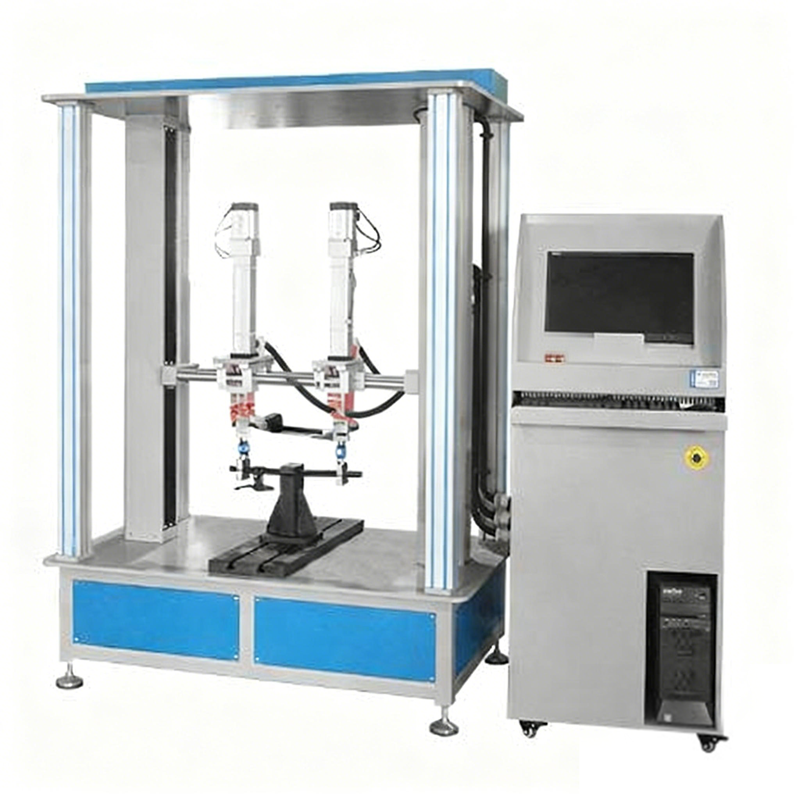


The Bicycle Handlebar Stem Static Load Tester is designed to evaluate the static load performance and structural durability of bicycle stems and handlebars. The machine simulates the forces experienced during riding, particularly over uneven surfaces, using a PLC touchscreen-controlled system. The force application system utilizes closed-loop control for precise loading and automatic return, allowing you to reliably assess handlebar strength and safety for design verification and quality improvement.
Application
This tester is suitable for:
(1) Durability and strength testing of bicycle stems and handlebars
(2) Road bikes, mountain bikes, and commuter bikes handlebar and stem evaluation
(3) Bicycle R&D, quality control, and production testing
(4) Third-party testing and certification laboratories
Compliance Standards
(1) GB/T 20096-2006 — Bicycle and Wheel Safety Performance Test Method
(2) QB/T 1884-2018 — Bicycle Component Fatigue Test Method
(3) ASTM F2264-14 — Scooter and Pedal Vehicle Durability Test
(4) EN 14766 — Bicycle Safety Performance Standard
(5) EN 14781 — Road Bicycle Handlebar and Stem Structural Standard
Technical Parameters
| Item | Technical Specification |
|---|---|
| Force Sensor Capacity | 2000 N |
| Force Application Device | Single pneumatic cylinder |
| Control Method | PLC touchscreen control |
| Test Cycles | 0–999,999 (adjustable) |
| Stop Mode | Manual stop / set value stop / safety switch stop |
| Fixtures Provided | One set of stem installation tooling |
| Base Design | Load-bearing shock-absorbing feet for stable operation |
| Power Supply | AC 220 V 50 Hz (default, customizable) |
Features
(1) Automatic Stop Function: Stops automatically when the preset cycle is reached or the specimen is damaged
(2) PLC Touchscreen Interface: Precise control of applied force, test cycles, and parameters
(3) Closed-Loop Force Control: Ensures accurate loading and repeatable, reliable data
(4) Adaptable Fixtures: Accommodates a variety of stem specifications
(5) Shock-Absorbing Base: Improves test stability and safety
(6) Data Storage: Test results can be saved for analysis and record-keeping
Accessories
| Accessory / Consumable | Description |
|---|---|
| Stem Installation Fixture | Customizable for standard or client-specified stems |
| Force Sensor | Accurate measurement of applied force |
| PLC Touchscreen | Test control and data recording |
| Pneumatic Cylinder Load Device | Single unit with precise force application |
| Safety Switch | Immediate stop in case of abnormal conditions |
| Power & Connection Cables | AC 220 V, 50 Hz |
| Maintenance Consumables | Lubricants and cleaning supplies |
Test Principle
The tester applies controlled force to the bicycle stem and handlebar using a pneumatic cylinder under closed-loop control. The force system automatically returns to the initial position after each cycle. The PLC touchscreen monitors force, cycle count, and test status in real time. When the test reaches the preset cycle count or if the stem or handlebar is damaged, the system automatically stops and saves the results.
Operation Instructions
(1) Secure the stem and handlebar assembly in the fixture.
(2) Connect the power and launch the PLC touchscreen interface.
(3) Set force, number of test cycles, and stop conditions.
(4) Start the test program; the system automatically applies cyclic force.
(5) Monitor force and cycles in real time; manually stop if necessary.
(6) Upon completion, save the data and clean fixtures and equipment.
(7) Regularly inspect the fixture and pneumatic cylinder, and maintain lubrication and cleanliness.
Test Procedures
(1) Install the stem and handlebar in the fixture and secure tightly.
(2) Set the applied force, number of cycles, and safety stop conditions.
(3) Start the test; the pneumatic cylinder applies cyclic loading.
(4) The system monitors force and cycles and automatically returns for the next cycle.
(5) Test ends automatically when preset cycles are reached or the component is damaged.
(6) Export test data to evaluate stem and handlebar durability and structural safety.
(7) Use results to adjust design or perform quality assessment.
Maintenance Information
(1) Regularly inspect fixtures and pneumatic cylinder for wear and stability.
(2) Keep the fixture and force application surfaces clean and lubricated.
(3) Check electrical connections and PLC system periodically.
(4) Ensure safety switches are functional before each test.
FAQ
1. What is this tester?
It is a static load testing machine designed to evaluate the durability and structural safety of bicycle stems and handlebars.
2. What is it used for?
To simulate static loads experienced during riding, particularly on uneven roads, and assess stem and handlebar strength.
3. How does it work?
A pneumatic cylinder applies force under closed-loop control, automatically returning for each cycle. PLC monitors force, cycles, and status, stopping automatically upon completion or damage.
4. Why is this tester important?
It ensures stem and handlebar safety, supports design validation, and helps improve bicycle quality.
5. What industries is it suitable for?
Bicycle manufacturing, R&D centers, quality control labs, and third-party testing institutions.
Leave Message Get Price