Bicycle Frame Horizontal & Vertical Durability Tester
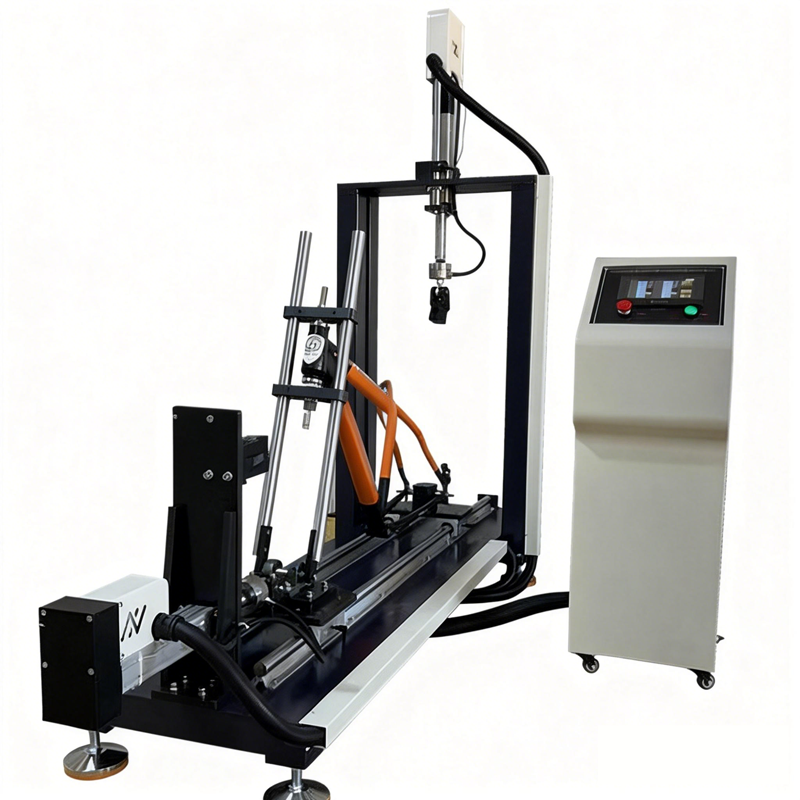


The Bicycle Frame Horizontal & Vertical Durability Tester is designed to simulate the horizontal and vertical load conditions experienced by bicycles during actual riding. You can use this tester to perform fatigue and durability testing on bicycle frames, evaluating long-term fatigue resistance and structural reliability. The device applies cyclic loads via servo cylinders, with force sensors operating in closed-loop control to ensure high loading accuracy. You can preset the number of cycles, and the system supports automatic direction reversal and automatic stop.
Application
This tester is suitable for:
(1) Fatigue and durability testing of all types of bicycle frames
(2) Mountain bikes, road bikes, and city bike frame testing
(3) Quality control and random inspections during bicycle production
(4) New model development and performance verification
(5) Use by third-party testing agencies and research laboratories
Standards
The tester complies with the following national and international standards:
(1) GB/T 20096-2006 — Bicycle Safety Technical Specification
(2) EN 14766 — Mountain Bicycles — Safety Requirements
(3) EN 14764 — Road Bicycles — Safety Requirements
(4) ASTM F2043 — Standard Test Method for Bicycle Frame Fatigue
(5) ISO 4210 Series — Bicycle Safety Requirements
Parameters
| Item | Technical Specification |
|---|---|
| Sensor Capacity | 2000 N |
| Load Cell Resolution | 1/10000 |
| Test Force Range | 0 – 2000 N (adjustable) |
| Force Control Accuracy | ±0–5% |
| Test Frequency | 5 Hz (adjustable) |
| Applicable Frame Wheelbase | 70 – 140 cm (customizable) |
| Test Cycles | 0 – 999,999 (adjustable) |
| Loading Method | Servo cylinder actuation |
| Control Method | PLC + touchscreen control |
| Power Supply | AC 220 V, 5 A |
| Frame Structure | 45# welded steel plate with sheet metal coating |
| Test Functions | Horizontal durability, Vertical durability |
Features
(1) Integrated horizontal and vertical durability testing
(2) Closed-loop force control ensures high loading accuracy
(3) Test force, frequency, and cycle count freely adjustable
(4) Automatic direction reversal and stop function for continuous testing stability
(5) Suitable for various bicycle frame sizes
(6) Strong structural rigidity for long-term continuous testing
(7) Intuitive operation interface, easy maintenance
Accessories
| Accessory / Consumable | Description |
|---|---|
| Force Sensor | 2000 N, high-precision closed-loop control |
| PLC Control System | Touchscreen interface, user-friendly operation |
| Servo Cylinder | Horizontal and vertical loading drive |
| Connecting Cables | Power and signal cables |
| Standard Fixture | Adjustable for different frame wheelbases |
| Steel Base | Provides stable support and vibration reduction |
| Lubricants / Maintenance Consumables | For periodic maintenance |
Test Principle
The tester applies cyclic horizontal and vertical loads to the bicycle frame via servo cylinders. Force sensors operate in closed-loop control to maintain the set force. When the target force is reached, the system automatically reverses direction for the return stroke. Horizontal loading simulates side-to-side forces during riding, while vertical loading simulates rider weight and ground impact. This ensures high-precision fatigue and durability testing.
Operation Instructions
(1) Securely mount the bicycle frame in the test area.
(2) Turn on the main power; the system performs self-checks and displays the PLC touchscreen interface.
(3) Set test parameters: loading force, frequency, number of cycles, etc.
(4) Start the test; the device automatically executes horizontal and vertical fatigue cycles.
(5) After the test, the system automatically stops, data are recorded, and the test area is cleared.
(6) Periodically inspect sensors, fixtures, and cables, and maintain lubrication and cleanliness.
Test Procedures
(1) Select the test mode (horizontal durability or vertical durability).
(2) Choose fixtures appropriate for the frame wheelbase and mount the frame.
(3) Set the test force, frequency, and number of cycles.
(4) Start the test and monitor force and cycle count in real time.
(5) At the end of the test, the PLC automatically stops the machine and saves data.
(6) Inspect the frame for structural changes, wear, or deformation.
Maintenance Information
(1) Regularly check the integrity of the servo cylinders and force sensors.
(2) Maintain cleanliness of fixtures and test area.
(3) Lubricate moving parts periodically.
(4) Verify calibration of sensors and PLC system for accurate results.
FAQ
1. What is this tester?
It is a fatigue durability tester for bicycle frames, capable of simulating horizontal and vertical loads during real-world riding.
2. What is this tester used for?
You can use it to evaluate frame structural integrity, fatigue resistance, and durability under cyclic loading.
3. What is the working principle of this tester?
Servo cylinders apply cyclic horizontal and vertical loads, with closed-loop force control. Automatic reversal and stop functions ensure precise and continuous fatigue testing.
4. Why is this tester important?
It helps ensure the structural safety and long-term reliability of bicycle frames before market release, aiding in product quality control and certification compliance.
5. What industries is this tester suitable for?
Bicycle manufacturers, quality control labs, R&D centers, third-party certification bodies, and research institutions.
6. What types or configurations are available?
The tester supports adjustable frame wheelbases, test force, frequency, and cycle counts, accommodating mountain bikes, road bikes, and city bikes.
Leave Message Get Price